
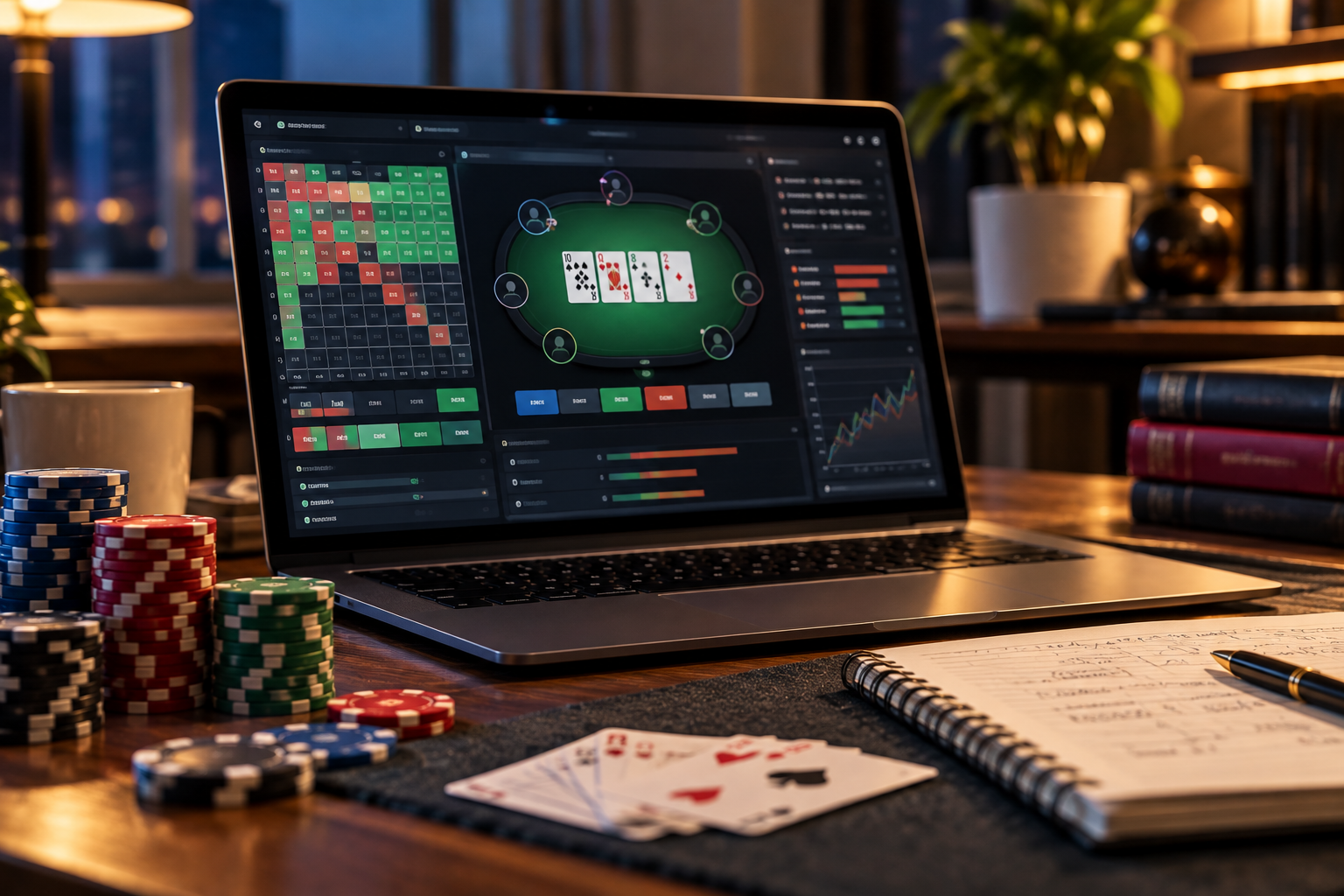
Poker study used to be comparatively blunt. Recreational players had hand histories, static charts, forum discussions and, for those willing to pay, private coaching. The newer generation of AI-assisted tools introduces something more useful: continuous diagnosis.
A player can now review hundreds of decisions, see where expected value was lost, isolate recurring errors and practise similar situations again. The software does not make difficult decisions disappear. Its real contribution is to make patterns visible sooner.


AI poker coaching is not one technology
The term “AI coach” hides several distinct products.
Some tools are built around pre-computed equilibrium solutions. Others behave like trainers, presenting a decision and grading the response against a reference strategy. Hand-history analyzers work at session level, sorting mistakes by position, street or expected-value loss. Simulated opponents create practice environments in which no bankroll is at risk.
For people studying online Poker, the distinction is more than technical. Someone trying to repair weak preflop habits has different needs from a player reviewing hundreds of postflop hands after a session.
Natural-language explanations add another layer. They can turn dense solver output into something easier to absorb, but they also create room for oversimplification. If the underlying solution is poorly matched to the game being studied, a fluent explanation does not make it more accurate.
Faster feedback makes practice more precise
The practical advantage lies in shortening the distance between decision and correction.
Traditional study often begins with whatever hand happened to be memorable. That can distort attention. An unusual bluff receives an hour of discussion while a routine mistake repeated dozens of times goes unnoticed.
Interactive training reverses that bias. Similar decisions can be presented in sequence, mistakes can be measured immediately, and the same category can be revisited days later.
That format fits established principles of deliberate practice and retrieval. The player must make a choice, receive feedback and try again rather than passively reading an answer. What remains unproven is the commercial claim that any particular product will reliably raise a casual player’s win rate. The evidence is stronger for the learning method than for guaranteed poker outcomes.
Leak detection gives hand histories a hierarchy
A long hand history contains too much information to study evenly. The useful question is which errors deserve attention first.
An analyzer can reveal that a player is opening too loosely from one position, defending the big blind too often, giving up too frequently on certain boards or failing to extract value in recurring situations. These are less memorable than a large lost pot, but repetition can make them more consequential.
The benefit is prioritization. Instead of wandering through interesting hands, a player can identify one frequent source of expected-value loss and build practice around it.
That is a more realistic use of AI for recreational players than attempting to reproduce an entire equilibrium strategy. The goal is not encyclopedic recall. It is to reduce the number of expensive decisions made for the same reason.
A solver is only as accurate as the game it models
Solver output often looks definitive because it arrives with exact frequencies and expected values. Those numbers need context.
A solution is conditional on the ranges supplied, effective stack depth, rake structure, available bet sizes and action tree. Tournament calculations may also depend on payouts and ICM assumptions. Change the model and the answer can move with it.
This becomes especially relevant in multiway pots, unusual live games, unconventional sizing patterns or situations that the software approximates rather than models directly.
A theoretically correct answer can therefore be practically misplaced.
For casual players, the stronger lesson is usually structural. Understanding why one range has an advantage on a given board, why certain hands prefer checking, or why some holdings block likely calls transfers better than memorizing an exact mixed frequency from one configuration.
Study ends where real-time assistance begins
The technical usefulness of these tools comes with a hard boundary.
Solvers, advanced charts, external analysis and outside advice may be prohibited when they influence a live decision. Poker-room policies differ, but the underlying distinction is straightforward: reviewing yesterday’s hands is study; consulting external strategic assistance while today’s hand is active may be treated as cheating.
Players should therefore separate analysis from play completely. Hands can be marked for later review, but live decisions should be made without external guidance.
That separation also keeps the purpose of coaching software clear. Its role is to improve recognition, reasoning and recall before the next decision occurs—not to supply the decision when the action reaches the player.
Stronger technical knowledge does not remove variance or guarantee profit. Poker should be treated as entertainment, and coaching software as an educational expense. Players should set firm time and loss limits, avoid using money needed for essential costs, never rely on borrowed funds to play and stop if gambling begins to damage finances, work, relationships or well-being.